

What Is Entity SEO?
Entity SEO is the practice of optimizing for how machines understand things rather than how they match words. An entity is a distinct concept with attributes and relationships, such as a company, a person, a product, or a technology category. Entity SEO makes your brand recognizable as one of those things, so systems can retrieve and describe it accurately.
The shift is from targeting a phrase to establishing an identity. Keyword optimization asks which words a page should contain to match a query. Entity optimization asks which concepts a brand should be associated with, how strongly, and with what supporting evidence, so that when a buyer asks a question in any phrasing, the system connects the question to your organization without needing an exact string match.
This is not a replacement for search fundamentals. Pages still need to be crawlable, fast, and well structured. What changes is the strategic layer above them: the work of deciding which concepts your brand should own, and then building the content, structure, and external corroboration that make that ownership legible to a machine.
For a CMO, the useful reframing is that entity SEO is closer to positioning than to technical marketing. The questions it asks are the ones a positioning exercise asks: what category are we in, what problem do we solve, who do we serve, and what makes us the obvious answer. The difference is that the conclusions have to be expressed in a form that machines can read and independent sources will repeat.
Why Are Brands, Not Keywords, the Unit of AI Search?
AI assistants do not return ten links for a buyer to evaluate. They return a synthesized answer that names a small number of options, usually three to five. Getting named requires the system to have a confident association between your brand and the problem being described, which is a property of the brand across the whole web rather than a property of any single page.
That changes the competitive math. In a ranked list, the eighth result still gets some traffic. In a synthesized answer, being the sixth-most-associated vendor in a category means being invisible for that query. The distribution is far more concentrated, which raises the value of category association and lowers the value of long-tail page count as a strategy on its own.
It also changes who wins. A brand with modest page volume but strong, consistent, well-corroborated association with a specific problem frequently outperforms a much larger site with broad but shallow coverage. Depth and consistency in a defined space beat breadth, because the system is trying to identify the most characteristic answer, not the most abundant one.
The buying behavior underneath this shift is worth stating plainly. B2B evaluation increasingly begins with a conversational question rather than a search box, and the shortlist that emerges from those first exchanges frames everything that follows. Vendors absent from that initial answer are not evaluated and rejected; they are never considered. That is a different failure mode from ranking on page two, and it demands a different response.
How Search Systems Moved From Strings to Things
Search engines began building entity databases more than a decade ago, mapping named things and their relationships rather than treating queries as bags of words. That work established the pattern: understand what a query refers to, then find sources that discuss that thing authoritatively. Language models extended the same logic, learning dense representations in which concepts sit near related concepts regardless of exact wording.
The practical effect is that synonyms, abbreviations, and paraphrases collapse into the same underlying concept. A buyer asking about vendor consolidation, tool sprawl, or platform rationalization is asking about closely related things, and a system that understands entities will treat them accordingly. Optimizing separately for each phrasing produces near-duplicate pages that compete with each other and add nothing to comprehension.
For B2B teams, this dissolves a familiar planning habit. Building content calendars from keyword volume tables tends to produce a long list of thin variations. Building them from a map of concepts, and the relationships between them, produces fewer and stronger assets. Most teams find that consolidating overlapping pages into fewer definitive ones improves both traditional rankings and assistant citation rates.
Relationships carry as much weight as the concepts themselves. A system that knows your product belongs to a category, integrates with a named platform, serves a defined industry, and addresses a specific compliance requirement can answer far more questions about you than one holding an isolated list of topics. Content that states those relationships explicitly, and internal linking that mirrors them, does more for comprehension than adding another article to the pile.
The Entity Gravity Model: Four Forces That Make a Brand Retrievable
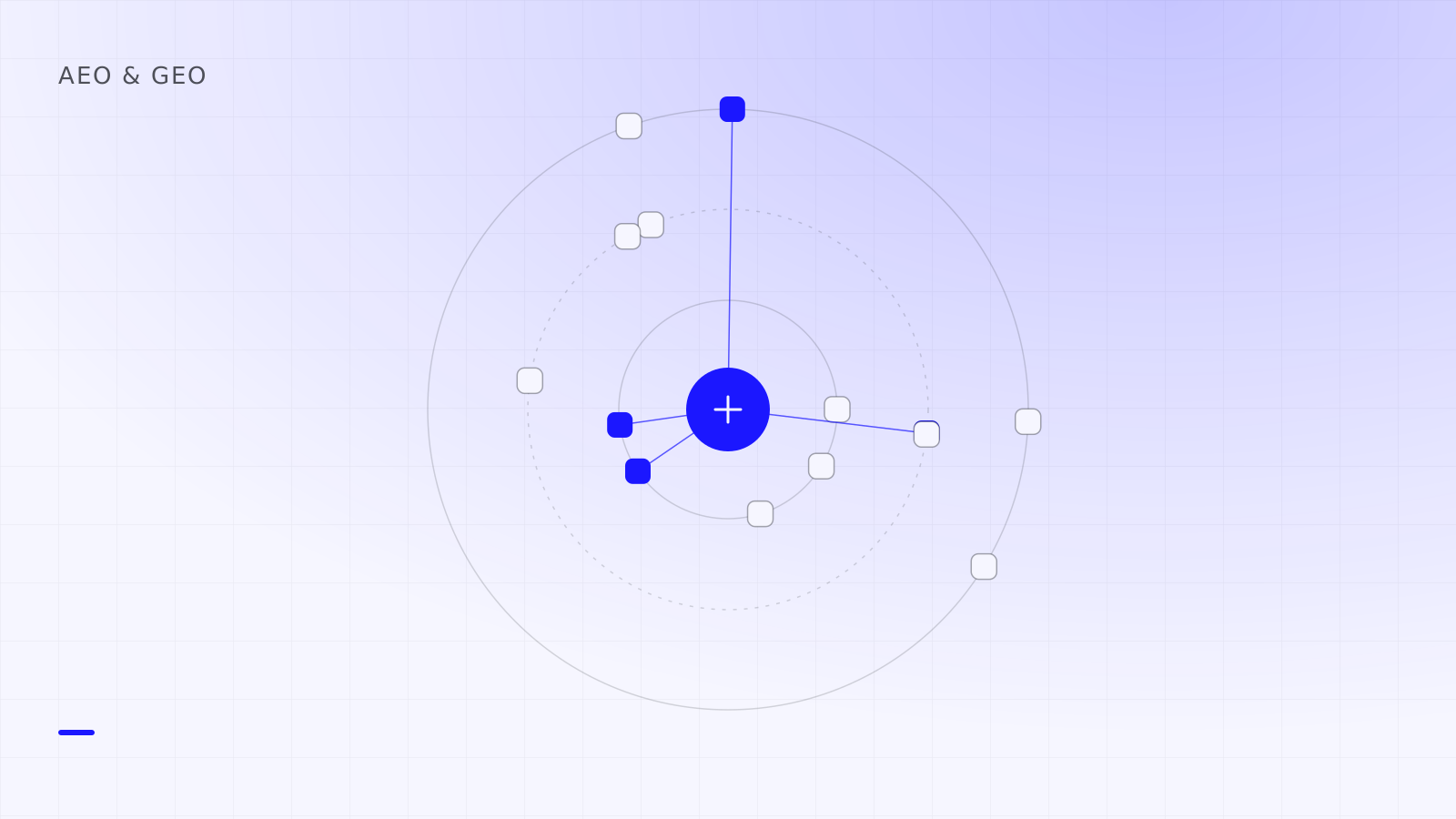
Think of retrievability as gravity: the more mass a brand has around a concept, the more likely a system is to pull it into an answer. The Entity Gravity Model describes four forces that generate that mass. The first is definition, meaning the clarity and consistency with which you state what your organization is, what it does, and for whom, across every surface a machine can read.
The second force is association, the density of substantive content connecting your brand to a specific set of problems, industries, and technologies. The third is corroboration, the degree to which independent sources repeat the same facts and framings about you: analyst mentions, editorial coverage, partner listings, review platforms, and knowledge bases. Self-declared claims contribute little without external agreement.
The fourth force is distinctiveness, the presence of proprietary material only your organization could publish. Original benchmarks, named methodologies, customer outcome data, and specific implementation detail give a system a reason to cite you rather than any of the twenty other vendors making similar generic claims. Distinctiveness is the force most B2B programs neglect and the one that compounds fastest.
Audited together, these four forces explain most of the variance we see between brands with similar traffic but very different assistant visibility. A useful exercise is to score each force from one to five, then invest in the lowest rather than the most comfortable. Definition and corroboration are usually addressable within a quarter; association and distinctiveness take two to four quarters of consistent publishing.
What Does Entity SEO Change About Content Production?
It changes the unit of planning from the article to the topic cluster, and the measure of success from page rank to concept ownership. Instead of publishing twenty adjacent posts on variations of the same question, teams build a smaller set of definitive assets covering a concept completely, with clear internal linking that expresses how the pieces relate to one another.
Writing style changes too. Assistants extract self-contained passages, which rewards content that answers a question directly in the opening sentences of each section, states specifics rather than generalities, and avoids burying conclusions under setup. Content written to be quoted whole performs differently from content written to be skimmed, and most enterprise blogs are still optimized for the latter.
Source discipline becomes a production requirement. Claims that carry numbers, timelines, and conditions are more likely to be reused than claims that are purely qualitative. That means content teams need access to real evidence, whether from customer results, product telemetry, or the sales organization, and a process for validating what gets published. This is a workflow change, not a copywriting change.
Volume expectations should be reset accordingly. Teams moving to this model commonly reduce output by half while increasing the depth and evidence density of each piece, and see better results within two to three quarters. The constraint is rarely writing capacity. It is access to subject matter experts and to real data, which is why the programs that succeed are the ones where product and sales leadership commit time to content, not just budget.
Common Mistakes When Brands Start Entity SEO
The most common mistake is treating it as a structured data project. Adding markup to a site that has no clear positioning, inconsistent naming, and no independent corroboration produces well-formed statements about an entity nobody can verify. Markup describes an identity; it does not create one. The definitional and editorial work has to come first, with schema as the machine-readable expression of it.
The second mistake is chasing breadth. Teams see that assistants answer many questions and respond by publishing across every topic adjacent to their category. This dilutes association: a brand connected weakly to forty concepts is less retrievable than one connected strongly to eight. Deciding what not to write about is as consequential as deciding what to write.
The third mistake is impatience with measurement. Assistant outputs vary between runs, so a single check tells you almost nothing. Establishing a fixed question panel, running it on a monthly cadence, and reading the trend over 8 to 12 weeks gives a usable signal. Teams that judge the program on week-two results usually abandon it just before the corroboration layer starts to take effect.
A fourth mistake is silence about competitors. Buyers ask assistants comparison questions constantly, and if your organization publishes nothing that positions itself against alternatives, the system assembles that comparison from sources you did not write, frequently competitor material. Publishing honest, specific comparison content is uncomfortable for many enterprise brands and is one of the more reliable ways to appear in the answers that matter most to pipeline.
Where Should a B2B Team Start?
Start with a baseline, not a build. Write down the twenty to forty questions a qualified buyer would ask an assistant on the way to a shortlist, run them, and record who gets named and how your brand is described when it appears. That exercise usually reveals more about strategy than any keyword export, because it shows exactly which concepts the market already associates with competitors.
From there, sequence the work: fix definition and naming consistency first, close corroboration gaps in profiles and directories second, then commit to a focused publishing plan on the few concepts you intend to own. Expect the first two to move within a quarter and the third to take longer. Entity strength accumulates; it does not switch on.
Lemniscate Growth approaches this as a pipeline question rather than a visibility one, since the value of being named by an assistant is only realized if the buyers seeing that answer are the ones your sales team wants. Its AEO checkers and GEO scorers in The GrowthGPT toolset exist to make the baseline measurable, so entity investment can be defended in the same terms as any other demand generation line item.