
Why does a website migration put AI visibility at greater risk than rankings?
A website migration puts AI visibility at greater risk than rankings because AI engines rebuild their view of a brand on their own crawl and index cycles, which lag Google by weeks. A technically clean replatform with correct redirects can still leave assistants citing removed URLs, stale answer text or missing schema long after organic traffic has recovered.
The asymmetry comes down to how each system stores knowledge. Classic search maintains a live index that Google refreshes aggressively for sites it already trusts, so a well-executed migration often recovers organic sessions within four to eight weeks. AI answer surfaces blend a slower retrieval index, a set of cached passages, grounding results from third-party sources and, in some cases, model weights that were fixed months earlier. Each of those layers updates on a different clock, and a migration invalidates all of them at once.
For enterprise marketing teams, the practical consequence is that migration risk reporting is now incomplete if it only tracks rankings, sessions and crawl errors. A brand can hold its positions and still lose a third of its citation footprint because the paragraphs that assistants used to quote were rewritten by a new design system, or because the new infrastructure quietly reset crawl permissions for answer engine bots.
Why AI citation recovery lags organic recovery
AI citation recovery typically lags organic recovery by four to eight weeks, and on larger migrations by a full quarter. Where organic sessions on a well-planned enterprise migration usually stabilize inside four to eight weeks, brands should plan for eight to sixteen weeks before citation volume returns to its pre-migration baseline, and longer for pages that were only cited occasionally in the first place.
Three mechanics drive the lag. Answer engines re-crawl at lower frequency than Google for most mid-sized domains, so a changed URL may sit unvisited for weeks. Retrieval indexes are rebuilt in batches rather than continuously, meaning a freshly crawled page can be known but not yet retrievable. And many assistants ground answers partly in third-party sources, so a directory listing, a review profile or an old syndication copy carrying the previous URL keeps feeding an outdated view of the site.
Volatility makes the lag harder to read. The same prompt run repeatedly can return different brands and different cited sources, so a single check on launch day tells you almost nothing. Measurement has to be run as a repeated sample, typically five to ten runs per prompt across at least two engines, with a directional read taken weekly rather than daily.
What specifically breaks AI citation during a replatform
Five things break AI citation during a replatform, and none of them are caught by a standard redirect audit. URL changes without a stable canonical entity, removed or rewritten answer paragraphs, schema dropped in the rebuild, JavaScript-only rendering, and robots and crawl rules reset by new infrastructure account for the large majority of post-migration citation loss.
URL change is the least dangerous of the five when redirects are clean, because most engines eventually follow them. The deeper problem is entity instability: if a product, service or location page changes its name, its identifier and its internal linking pattern at the same time, the engine has no continuity signal and treats the destination as a new document with no accumulated authority. Preserving one stable canonical entity per concept, even when the URL and design change, is what carries recognition across the migration.
Rewritten answer text is the most underestimated cause. Design refreshes routinely replace a plain definition paragraph with a hero statement, a carousel or a set of short feature blurbs, which removes the extractable forty to sixty word passage the assistant was quoting. Schema loss follows the same pattern: Organization, Product, FAQPage and Article markup that was hand-added to the old templates often does not survive a component-based rebuild unless someone explicitly ports it.
Infrastructure resets are the quietest failure. A new CDN or hosting layer arrives with its own defaults, and in 2026 those defaults increasingly deny AI crawlers. Cloudflare now blocks AI crawlers by default and operates a Pay Per Crawl model, which means any site moving onto it makes an explicit allow or deny decision per bot category, often without the marketing team being consulted.
The five-stage migration sequence: Baseline and Preserve
The migration sequence that protects AI visibility has five stages: Baseline, Preserve, Signal, Verify and Recover. Baseline and Preserve happen before launch, and skipping them makes everything after launch guesswork, because without a recorded pre-migration citation profile there is no way to prove a drop happened or to see which surfaces recovered.
Baseline means capturing what the brand looks like to AI engines before anything moves. Build a prompt set of roughly forty to eighty buyer prompts spanning category questions, comparison questions, use case questions and branded questions. Run each prompt several times across at least two assistants, and record which of your URLs were cited, which competitor domains appeared alongside you, which third-party sources were used to describe you, and the exact passages that were quoted. That last item is the asset most teams fail to capture and most regret losing.
Preserve means protecting the things that earned those citations. Port every quoted passage into the new templates in substantially the same wording and the same position on the page, near the top and in plain body text rather than inside an accordion or a tab. Carry schema forward as a build requirement with automated validation in the deployment pipeline, not as a post-launch task. Keep one canonical entity per concept, maintain internal link paths to the pages that were cited most, and write the redirect map at the passage level as well as the URL level, so you know where each cited answer now lives.
Signal and Verify: the launch-week checks that protect citation
Signal and Verify are launch-week stages, and they are where most of the recoverable damage is either prevented or locked in. Signal means actively telling engines the site has changed rather than waiting to be discovered, and Verify means confirming within seven days that the new site is reachable, renderable and structurally intact for every crawler that matters.
Signaling starts with submitting refreshed sitemaps, keeping the old sitemap live with redirect targets for two to four weeks, and updating the third-party surfaces that assistants ground on. Directory profiles, review platforms, partner pages, documentation portals and social profiles all carry old URLs, and every one that still points at a dead path extends the period during which an engine holds a stale view. Prioritize the ten to twenty external sources that appeared most often in the baseline sample.
Verification is a fixed checklist run in the first week. Fetch key pages as each major AI crawler user agent and confirm a 200 response rather than a challenge page or a bot block. Confirm the new CDN or WAF has explicit allow rules for answer engine crawlers and that the September crawler category separation has not silently reclassified them. Render key pages with JavaScript disabled and confirm the answer paragraph, headings and schema are present in the raw HTML. Validate structured data at scale rather than on a sample of five pages. Then rerun the full baseline prompt set and compare citation counts against the pre-migration record.
Recover: what to do when citations drop after launch
Recover is the stage for a confirmed citation drop, and it should be triggered by a two-week trend rather than a single bad reading. If repeated prompt runs show citation volume down more than twenty to thirty percent against baseline after fourteen days, treat it as a defect to be diagnosed rather than a delay to be waited out.
Diagnosis follows the same order as the failure modes. First confirm access: server logs will show whether AI crawlers are reaching the new site at all, and a sudden absence of a user agent that was active before launch is the fastest signal of a blocked bot. Second confirm rendering and structure on the specific URLs that lost citations. Third compare the current page text against the passages recorded in the baseline, because in a large share of cases the answer simply is not on the page anymore in a quotable form.
Remediation is narrow and sequenced. Restore access first, restore extractable answer text second, restore schema third, and only then look at content expansion. Refresh the pages that lost the most citations so they carry a genuine update date, rebuild the third-party references that still point at old URLs, and resist the temptation to publish new content as a substitute for repairing what was already trusted. Recovery after a correct remediation typically shows in citation samples within three to six weeks, with full return to baseline in eight to twelve.
What a normal post-migration AI visibility curve looks like
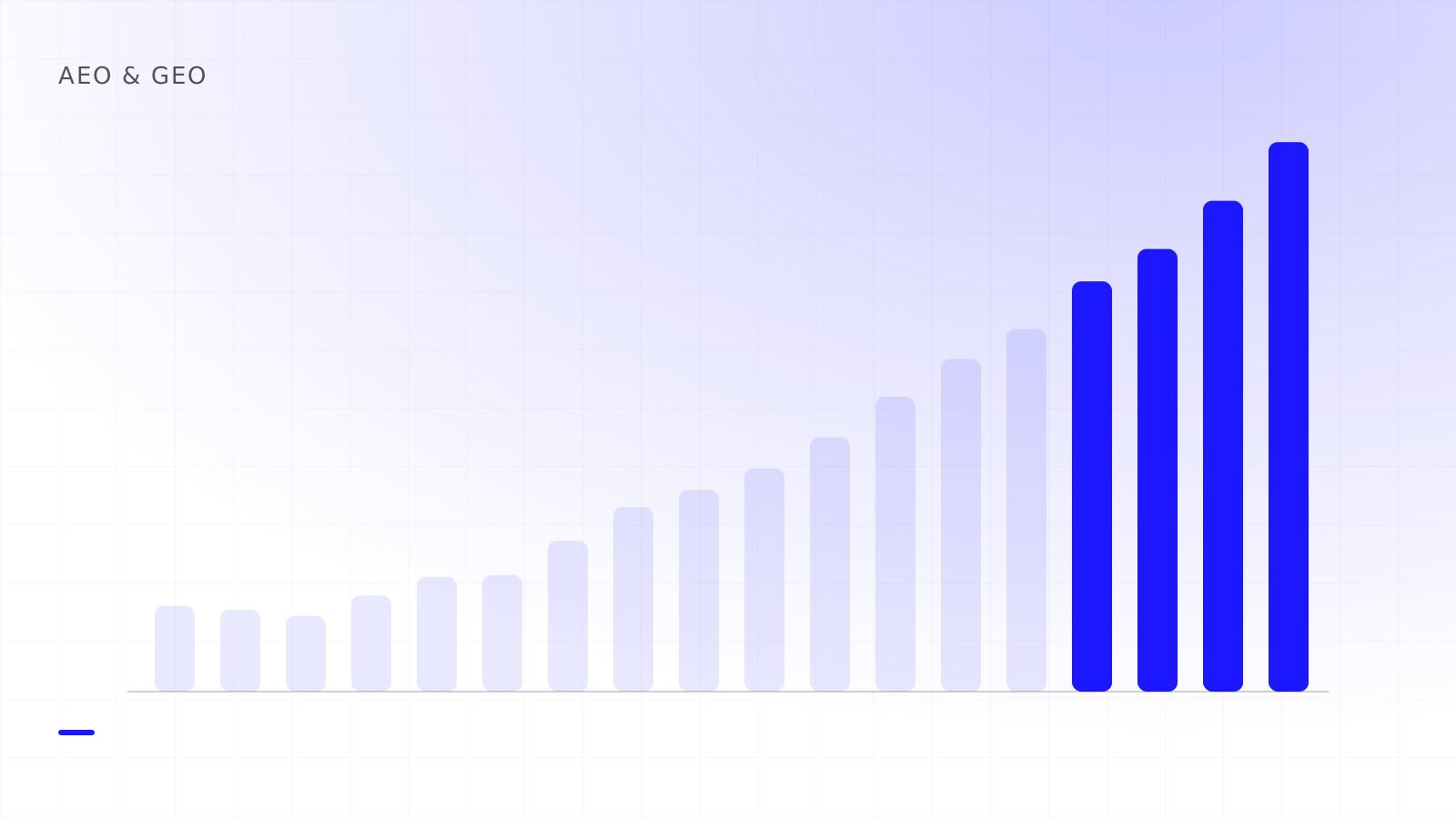
A normal post-migration AI visibility curve dips for two to four weeks, flattens, and then climbs back over the following one to two months. Expect a visible citation decline in the first fortnight even on a well-executed migration, and judge the migration on the shape of weeks three through ten rather than on the first reading after launch.
Set expectations with executives before launch, because the reporting gap between organic and AI recovery generates avoidable escalation. Organic sessions returning to normal while citation volume is still down forty percent is an expected pattern, not evidence that the migration failed. Give leadership a single weekly view that shows both curves side by side, with the baseline drawn as a fixed line, so the lag reads as a known behavior of the channel.
The migrations that recover fastest share three traits. They kept answer paragraphs intact in wording and position, they treated crawler access as a launch blocker rather than a follow-up ticket, and they held a recorded baseline detailed enough to prove which specific passages and URLs stopped being cited. Zero-click behavior has intensified to the point where the citation itself is often the whole commercial return from a page, so protecting it deserves the same rigor as protecting revenue-bearing URLs.
How to build migration readiness into an ongoing AI visibility program
Migration readiness is best built as a standing capability rather than a project task, because the baseline is only useful if it already exists when the replatform is approved. Teams that run a continuous citation baseline across a fixed prompt set can start a migration with months of history, which turns post-launch diagnosis from an argument into a comparison.
That means owning three things year-round: a maintained prompt inventory that reflects how buyers actually ask about the category, a scheduled multi-run citation measurement across at least two engines, and a documented register of the passages and schema blocks that earn citations. Free tooling covers more of this than most teams assume, and Lemniscate Growth maintains The GrowthGPT, a platform of more than one hundred tools including AEO checkers, AI citation checkers and GEO scorers, for exactly this kind of repeated measurement.
Where migration work connects to pipeline is in the recovery window. A quarter of suppressed citation on high-intent comparison and evaluation pages is a quarter of suppressed demand, which is why Lemniscate Growth treats AI visibility continuity as part of pipeline planning rather than a technical afterthought. The five stages are not complicated. They fail when Baseline is skipped, and everything downstream becomes an argument about whether anything was lost at all.