

Most international recruitment conversations start with a number nobody can act on: enquiries are up, applications are flat. The enquiries are usually real. The leak sits somewhere between them and a student in a seat, and without stage level data the discussion collapses into an argument about lead quality that nobody can win.
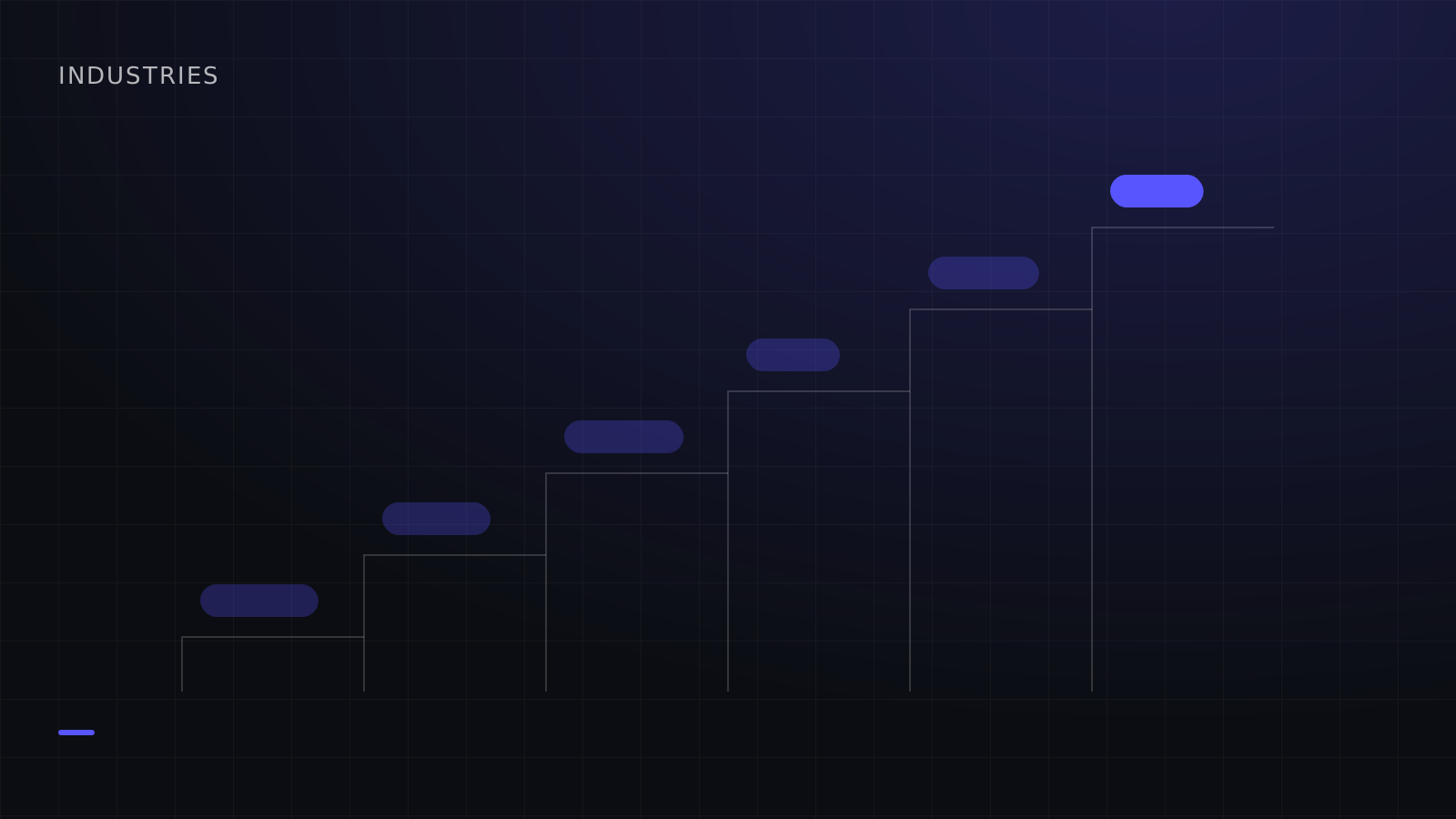
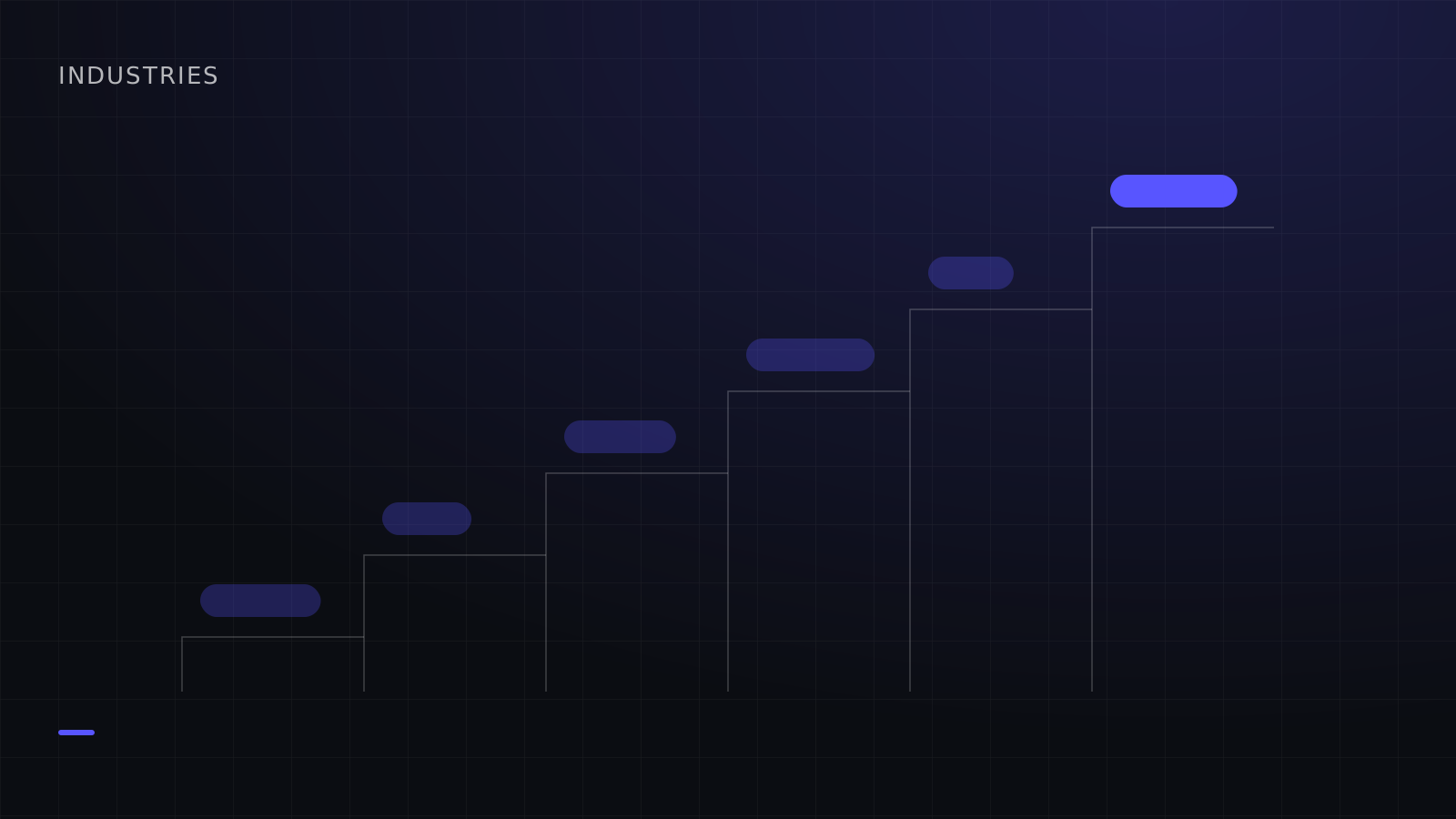
This is the audit we run when a university knows the funnel is not converting but cannot say where. It walks six stages, names the team that owns each one inside the institution, lists the specific failures we keep finding, and states the one metric that would have made the failure visible. It is the same sequence our international marketing and admissions work follows before anything gets rebuilt.
One rule before the stages. Measure the joins, not the boxes. Every stage loses people, and each one in isolation looks tolerable. The damage shows at the handoffs, and the two costliest handoffs are enquiry to application and offer to deposit, because both are moments when the student has to act and the university has gone quiet.
Stage 1: Reach
What the stage really is. Everything that happens before the student is known to you. A search result, an AI assistant's answer, a consultant's shortlist, a WhatsApp group, a ranking listing, an alumnus talking about their first winter. This is the only stage where you compete without knowing you are competing, and the only one where the shortlist is decided without you in the room.
Who owns it. Central marketing owns the channels, the international office owns the markets, and in practice a large share of reach is rented from intermediaries. An AIRC and BONARD survey of 155 US universities, reported by ICEF Monitor on July 10, 2025, found 75 percent of responding institutions working with education agents in 2024, against 37 percent in 2016. Rented reach is not wrong, but it means someone else writes the first description of your university.
Three failures cause most of the loss here.
- The page a family lands on was written for domestic students. Fees in one currency, entry requirements expressed in a qualification nobody in that country holds, no visa or work rights page, no date anywhere. The student cannot tell whether they are eligible, so they ask someone who will guess.
- There is no page for the market or the program. The query gets answered by an aggregator or a consultant's comparison page that ranks you against four competitors, and the enquiry is captured there, not by you.
- Reach is reported in impressions and followers. Those numbers cannot be joined to an enquiry later, so the channel that produced students and the channel that produced noise look identical at the end of the intake.
What to measure. Enquiries by source market and program, split by organic search, AI assistants, paid, referral, partner code and event. Then the number almost nobody has: the share of enquiries arriving with no traceable source. That percentage is the ceiling on every other conclusion you will draw this intake.
The fix. Publish one page per source market and one per program that states eligibility with the local qualification named, total cost, funding proof, work rights and the visa steps, each with the date it was checked, the official source linked and a named owner who updates it. Give every campaign and every partner a code so reach becomes an attributable source. Our note on AEO for higher education covers the page structure that gets quoted rather than skimmed.
Stage 2: Enquiry
What the stage really is. The moment a stranger becomes a named person with a question. A form, a WhatsApp message, an Instagram DM, a phone call, a badge scan at an event, a handover from a consultant.
Who owns it. This is the split that causes the leak. Marketing owns the form and the ad that fed it. Admissions owns the reply. Nobody owns the gap between them, and the gap is where the enquiry dies.
Three failures cause most of the loss here.
- The form asks for a passport number before it asks what the student wants to study. Date of birth, full address, agent code and identity documents up front, and the one question that would let a counselor have a useful conversation, which program and which intake, is missing or optional. Identity documents requested before anything has been offered read as a screening step, not a conversation.
- The reply arrives in two weeks, or on the wrong channel. A WhatsApp enquiry answered by email is an unanswered enquiry. A reply from a no reply address is an unanswered enquiry. A reply sent at 4pm campus time to a family eight time zones away is answered tomorrow at best.
- No enquiry has an owner. Three people read the shared inbox, each assumes another has picked it up, and the follow up sequence is a newsletter. Meanwhile the family has asked a consultant, who answered in minutes and with confidence.
We are deliberately not quoting the lead response time statistics that circulate in this sector. Several of the best known ones trace back to studies whose method or date we could not confirm, and a university does not need a benchmark to know that a two week reply is a lost student.
What to measure. Time to first human reply, by channel and by hour in the student's time zone, reported as a median and a worst case rather than an average. The share of enquiries with a named owner and a dated next step within one working day. Form starts against form completions, with the field where people abandon.
The fix. Cut the first form to program, intake, country of residence, current level and one contact method the student actually uses. Reply on the channel the enquiry arrived on, within a target agreed with admissions in hours rather than days, and put that target on a daily report someone reads. Assign an owner at the moment the enquiry lands, automatically, with the parent's contact captured as a second name on the record rather than an afterthought.
Stage 3: Application
What the stage really is. The student spends real effort. Transcripts, an English test, a passport scan, a statement, a fee, and often a parent's signature.
Who owns it. Admissions operations owns the process, IT owns the portal, faculty owns eligibility. Three owners, one abandonment rate, and usually no shared view of where it happens.
Three failures cause most of the loss here.
- The portal will not accept documents from their country. No option for their examination board, a marksheet that does not match the required naming, a schooling length rule nobody explains, a required phone or postcode format that only accepts domestic values, a file size limit that a scanned transcript cannot meet.
- Eligibility is never stated plainly. Students who cannot be admitted apply anyway and are rejected weeks later, while students who would have been admitted assume they do not qualify and never start. Both look like the same abandonment number.
- Nobody chases an incomplete application. Most applications do not fail, they stall. One missing document, no follow up with a name and a date on it, and the file sits until the intake closes.
What to measure. Applications started against submitted, by market and program. The exact field or document where each abandonment happens. Days from start to submission. The share of applications sitting incomplete right now, and how many of last intake's incomplete files were recovered by a human.
The fix. Publish a qualification equivalence table per country and a document checklist that names the document as the student's school or university names it. Test the portal end to end from each major source market on a mobile connection, with real documents, once per intake. Turn incomplete applications into a work queue with an owner and dated follow ups, not a report that gets circulated.
Stage 4: Offer
What the stage really is. The university answers. Conditional or unconditional, and if conditional, with conditions that the student now has to clear alone.
Who owns it. The admissions committee and faculty own the decision. Communications usually owns nothing at all here, which is exactly why the letter reads like a legal notice.
Three failures cause most of the loss here.
- The offer letter carries conditions nobody explains. Subject to satisfactory English, pending final transcripts, subject to verification. No named document, no deadline in the student's calendar, no person to send it to. Families read that as uncertainty and hold their money.
- The decision arrives after a competitor's. In a market with a visa deadline behind it, the second offer usually loses, however good the program is.
- The offer goes to one email as one PDF. Not to the parent who will pay, not in a form a bank will accept for a loan or a visa officer will accept as evidence, and with no plain language summary of what happens next.
What to measure. Days from submitted application to decision, by program and by reviewer. The share of offers issued with conditions, and the median days to clear each type of condition. Offer to deposit rate by market. How many offer emails are never opened, which is a deliverability problem masquerading as a conversion problem.
The fix. Send the formal letter and a plain language page together. The page names each condition, the exact document that clears it, the date it is needed by, and the person who receives it. Publish an internal decision time standard and report against it weekly. Copy the parent when the student has told you who that is.
Stage 5: Deposit and visa
What the stage really is. Money moves and a government decides. Two different risks in one stage, which is why it tends to be measured as one thing and understood as neither.
Who owns it. Finance owns the payment, compliance or the international office owns visa guidance, admissions owns the relationship. Three owners means the student owns the coordination.
Three failures cause most of the loss here.
- The deposit page takes one currency and one card scheme. No local payment method, no bank transfer instructions in a format the student's bank accepts, and when a card is blocked for an international transaction the failure is silent. Nobody at the university learns that a committed student tried three times and stopped.
- The funding page is out of date. For applications received on or after September 1, 2026, IRCC lists CAD 23,448 a year in living costs for a single applicant outside Quebec, up from CAD 22,895, with CAD 6,318 for each additional family member, and those amounts exclude tuition and travel. A page still quoting last year's figure sends the student to file a document set that is wrong before it is submitted.
- Visa steps are handed to a consultant with no record kept. The university finds out about refusals after the intake has closed, by which point nothing can be rebuilt and nobody can say which partner or which market produced them.
What to measure. Deposits paid by payment method and country, and failed payment attempts, which is the single most useful number almost no university collects. Days from offer to deposit. Visa applied, granted, refused and withdrawn per market and per partner code, with refusal reasons. Deposit to enrolled, so that melt between payment and arrival is counted as a stage rather than a surprise.
The fix. Accept local payment methods in the student's currency and log every failed attempt as an event with an owner. Keep one dated funding and visa page per destination and per source market, linked to the official source, with the date it was last checked in the text. Point students at the official waiting time tools rather than quoting a processing time in your own copy, because those change: IRCC's processing times tool and the UK guidance on visa decision waiting times. Give guidance and the official link, never a guarantee about an outcome, and record each deposited student's visa milestone dates so the intake can be forecast instead of hoped for.
Stage 6: Enrolled
What the stage really is. The student arrives, registers, attends and stays through the first semester. Enrollment is a registry fact, and that is precisely why it rarely gets connected back to the enquiry that produced it.
Who owns it. Registry and student services. Marketing usually never sees this data, and the international office sees a total rather than a breakdown by source.
Three failures cause most of the loss here.
- Enrolled records are not joined to enquiry records. The best available report becomes cost per lead, so the team optimizes for leads, and the market that produces cheap enquiries beats the market that produces students.
- Melt is not counted. Students who paid, got a visa and never arrived are absorbed into a variance rather than treated as a stage with its own causes, which are usually housing, a family decision, or a competitor's later offer.
- The arriving cohort is never asked what they were told. Misrepresentation by a partner then surfaces as a complaint in month three, or as a review in the home market that outlives the partner relationship, rather than as a data point in week one.
What to measure. Enrolled students by original source, market, program and partner code. Deposit to enrolled and offer to enrolled. First semester retention by source, which is how you learn that your cheapest channel is also your least stable. A five question arrival survey asking what the student was promised, and by whom.
The fix. Make original source a required field that travels from first touch into the registry record, reconcile enquiry data against the registry once per intake, and route the arrival survey results back to both marketing and partner management with a named owner for each finding.
What to instrument so the leak is visible next intake
None of the above works as a one off analysis. It works when the events exist while the intake is running. Plainly stated, here is the minimum.
The identifier that has to survive
The events to track. Enquiry submitted, first human reply sent, counseling call held, application started, application submitted, document received, decision issued, condition cleared, deposit attempted, deposit paid, visa applied, visa decided, enrolled, withdrawn. Track the attempts as well as the completions. Deposit attempted and application started are where the leaks actually live, and most analytics setups only record the happy path.
What the CRM must capture. One record per person rather than one per form fill, because the same student will fill three forms and two of them will use a parent's email. Original source and most recent source held in separate fields, so nothing overwrites the first touch. Partner code. Market and city. Program and intake. Channel of first contact and of each reply. A named owner and a dated next step at every stage. A reason code when someone is lost, chosen from a short list the team agreed rather than free text. The registry identifier once the student enrolls.
Why enquiry source has to survive all the way to enrolled. Every decision made between intakes is a decision about sources: which markets to fund, which partners to keep, which programs to promote, which pages to build. If source dies at the application stage, those decisions get made on cost per lead, which rewards the cheapest lead rather than the market that produces students who arrive and stay. Source surviving to the registry record is also the only way to hold a partner network to account, since visa refusals and complaints by partner code are the earliest honest signal that someone is promising things you never said.
For St. Martinus University, a medical school in Curaçao recruiting from India and the United States, that meant treating the missing pieces as the work itself: an admissions flow with defined stages and named owners, counseling in the family's own language, and tracking from lead source to admission where previously there was none. The campaigns were never the hard part.
| Stage | Owner inside the university | The one metric that exposes the leak |
|---|---|---|
| Reach | Marketing and the international office | Share of enquiries with no traceable source |
| Enquiry | Marketing and admissions, jointly | Median and worst case time to first human reply, by channel |
| Application | Admissions operations, with IT | Started against submitted, and the field where people stop |
| Offer | Admissions committee and faculty | Days to decision, and median days to clear each condition |
| Deposit and visa | Finance, compliance, admissions | Failed payment attempts, and visa outcomes by partner code |
| Enrolled | Registry and student services | Enrolled by original source, and first semester retention by source |
A deliberate omission: there are no benchmark conversion rates in that table. Enquiry to application rates are not comparable between institutions, because nobody defines an enquiry the same way and few define it in writing at all. Your own last intake, measured consistently, is a better benchmark than any sector average, and the first job is usually to write down what an enquiry is.
The timing problem
The work that decides an intake happens roughly two quarters before the deadline, and this is the part that gets planned last.
A page published in the month applications close cannot rank, be cited or be found in time.
That is not a content marketing opinion, it is mechanics. A new page has to be crawled, indexed, linked from somewhere credible and then quoted before an assistant or a search result will hand it to a family. A webinar needs an audience that was built before the invitation. Alumni stories need alumni who agreed to be filmed. Consultants build their student pipelines for an intake well ahead of your campaign, so a partner briefed in the closing month is briefed for the intake after this one. Visa appointments and funding proof have their own lead times sitting behind the deadline, not in front of it.
What can still be fixed inside weeks is everything that depends only on your own operations: reply time and reply channel, who owns an enquiry, the clarity of the offer letter, the payment methods on the deposit page, the dates on the funding pages, and the follow up on stalled applications. Those are worth doing immediately and in any month of the cycle. What cannot be compressed is visibility and trust, which is why the same audit that looks backwards at the last intake is also the plan for the one two quarters out. The country level shifts feeding those plans move just as fast, which we cover in the 2027 intake reset for Indian students.
One more timing trap. The measurement at the end of an intake is what tells you what to build before the next one, so the instrumentation has to exist before the intake starts. A team that decides to measure the funnel after a disappointing cycle has already lost the data that would have explained it, and spends the following cycle guessing again.
Run this on your own funnel
Take the six stages, write the name of a person next to each one, and then try to produce the metric in the third column of the table above. The stages where you cannot produce the number are the stages where the leak is, whatever the dashboard says. That exercise usually takes an afternoon and it changes the conversation from lead quality to ownership.
The first ninety days
Lemniscate Growth works as an international marketing and admissions arm for universities, which is where this audit comes from. If it would help to run it with someone who has done it before, book a university strategy session and bring your last intake's numbers, however incomplete they are. The gaps are the finding. Our wider higher education practice covers the positioning, search and AI visibility, and admissions channels that sit behind the funnel.
This post describes operating practice, not immigration advice. Figures quoted carry their source and date. Nothing here promises an admission or a visa outcome, and no university should let a page or a partner imply otherwise.